
Lodging
Where to Stay in Cape Town: Choose a Base for Your Itinerary
Compare the City Bowl, Waterfront, Sea Point and Camps Bay against Cape Town's spread-out geography, airport arrival and trip length.
How long is your visit?
Choose an itinerary, or read the full guide below.
Check the full guide for arrival, ticket, accessibility and booking details.
Where to stay in Cape Town: choose a base for your itinerary
Cape Town’s mountain, harbour and Atlantic coastline make the city beautiful and geographically spread out. The City Bowl, V&A Waterfront, Sea Point and Camps Bay each create a different daily rhythm. Choose a base by the places you plan to visit, your arrival time and your willingness to use taxis, buses or a rental car. A room beside the sea can be a poor fit for a short museum-and-city stay if every dinner and activity requires a long cross-town transfer.
Choose a neighbourhood
City Bowl, Gardens and central CBD: This base suits first visits centered on museums, historic streets, restaurants and city activities. Cape Town Tourism describes the Central City as a City Bowl district with restaurants, coffee shops, shops and nightlife. Gardens adds a greener residential feel near the lower mountain slopes, while CBD and Foreshore put you closer to the civic centre, convention district and Waterfront approaches. These areas are not flat everywhere; check the exact address, walking route and parking arrangements, especially if you plan to return late.
V&A Waterfront and Green Point: Choose the Waterfront if you want to be near the harbour precinct, Two Oceans Aquarium, boat departures and the Oranjezicht market. It is a concentrated visitor district with dining and shopping, but a hotel described as “near the Waterfront” may still require a shuttle or ride. Green Point is a separate adjoining base with residential streets, parks and access to the coastal promenade. Staying here does not make Cape Point, Constantia or the Winelands close.
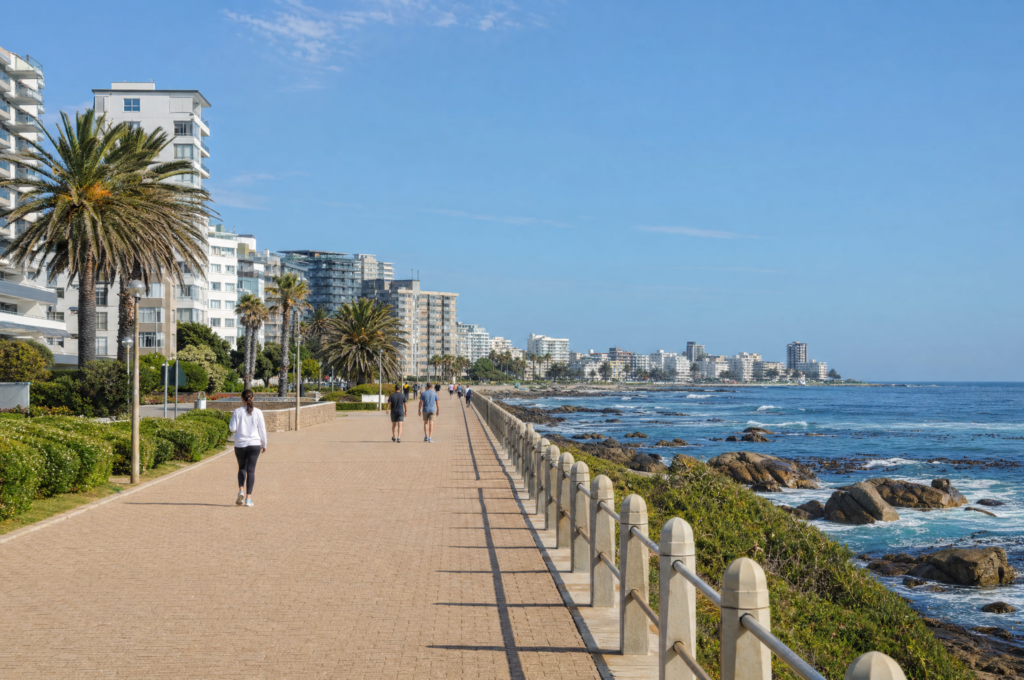
Sea Point: Sea Point sits between Signal Hill and the Atlantic and is known for its paved promenade, local restaurants and shops along Main and Regent roads. It works well for travelers who want a coastal daily walk and access to the central city by route-planned transit or taxi. It is not beachfront resort isolation: busy roads and apartment blocks shape much of the area, and some lodging lies uphill from Beach Road. Verify the exact address and the climb or crossing to the promenade if mobility, luggage or children affect the choice.
Camps Bay and Clifton: These areas put beach and Atlantic views first, with restaurants clustered along Victoria Road in Camps Bay. They fit visitors with time for coastal days or who plan to spend much of the stay locally. For a short first visit, account for the extra drive or bus journey to museums and the city centre. Cape Town Tourism warns of strong backwash at Camps Bay; sea conditions vary, so follow lifeguard and local beach guidance rather than treating an ocean swim as guaranteed.
Woodstock, Observatory and southern suburbs: These can suit guests with a specific event, university, food or family connection, or a longer trip with a rental car. They are distinct districts rather than extensions of the Waterfront. If your main plans are Atlantic beaches and central attractions, compare the actual door-to-door route before choosing them. Constantia is a separate suburban base for wine estates and gardens, but adds travel time to harbour and city visits.
Examples to compare
Waterfront/Foreshore: AC Hotel Cape Town Waterfront’s Marriott page gives its address as Dockrail Road in the Foreshore and describes it as near the CBD and Waterfront. The page is inconsistent about transport: its overview lists a scheduled shuttle toward the V&A Waterfront and CTICC, while its FAQ says the hotel does not provide shuttle service. Confirm directly with the property before relying on a transfer, and ask about current stops, times and luggage. City Lodge Hotel V&A Waterfront lists its address as 47 Alfred Street in Cape Town City Centre and places itself within reach of the precinct. These are different locations and operating models: compare exact addresses and verify how you would reach attractions on your dates.
Sea Point: Premier Hotel Cape Town is at 1 Marais Road, Sea Point. Its direct site presents it as a coastal base and publishes room categories and on-site dining; inventory, rates and room configurations change, so use the operator’s live booking page for your dates. Ask which room types suit your party and whether a specific view, step-free route, bath or other feature is available in the room you would reserve. Its address helps you judge promenade access, but does not promise that every room or route suits every mobility need.
These operator examples establish location and property information, not a ranking. Read cancellation terms and contact the hotel directly about family occupancy, accessible rooms, quiet-room requests, parking, transfers and late arrival. Hotel facilities can change, and an accessibility label does not answer every room-specific question.
Airport and local transport
Cape Town International Airport is outside the central visitor districts. Its official transport page lists authorised taxi and shuttle providers and advises travelers to use the official kiosk or authorised options rather than accepting unsolicited offers. Arrange a pickup plan that matches landing time and hotel check-in. For late arrivals, luggage-heavy groups or families with car seats, ask the hotel about transfer options and confirm a licensed operator directly.
Do not assume an airport bus is running: MyCiTi currently marks its Airport service temporarily suspended. The operator provides a city route map, live trip planner and service updates; these can help after arrival, but are not a substitute for checking your specific hotel-to-attraction journey. MyCiTi serves selected corridors, and a bus stop may still leave a walk or transfer. A rental car is useful for a wider Peninsula or Winelands itinerary, but parking and traffic add work in central neighborhoods. Use a separate plan for each day instead of assuming one transport mode reaches every destination.
Match your stay to the trip length
One night, two sightseeing days: If you arrive early and leave late, choose the City Bowl/Foreshore or Waterfront according to your first and last activities. Keep the first afternoon close to the hotel and avoid crossing town after a long flight. With a late arrival or early departure, the stay is effectively an arrival night and a departure night; do not count those as full sightseeing days. Confirm check-in, luggage storage and airport-transfer arrangements before choosing a tight schedule.
Two nights, two full days: Use one central base and group the City Bowl with Bo-Kaap, then dedicate the other day to either the Waterfront/Green Point or Atlantic Seaboard. Sea Point offers a middle ground for a coastal day and city access; Camps Bay works better when the beach and promenade are central to your plans. Avoid changing hotels for a two-night visit: packing and transfer time can take away a substantial part of the trip.
Three nights, three full days: Stay put and use one day for the central city, one for the harbour and nearby areas, and one for a coastal or Peninsula outing. A longer stay can make a second base worthwhile only if the next part of the trip has a clear focus, such as several nights in Constantia or on the Peninsula. Recheck road conditions, attraction access and transport before committing to a day crossing the metropolitan area. Changing hotels does not make far-apart districts adjacent.
Families, access and comfort
Ask a property about details that affect your party: lift access from street to reception, step-free route from room to breakfast, child bed or cot, connecting rooms, pool rules and secure luggage storage. For a mobility need, request dimensions or photographs of the actual room and bathroom instead of relying on a general “accessible” label. Older City Bowl buildings and steep side streets can be challenging with a stroller or luggage even when the hotel itself has a lift.
For families choosing the coast, compare a lodging address with the actual beach route and ask about supervised swimming options for the season. The ocean can be cold and rough, and conditions change. Sea Point’s promenade is a paved walking route; Camps Bay’s backwash and surf deserve particular caution. These neighborhoods also have distinct evening and transport patterns, so plan a return after dinner rather than deciding on the street.
Sources and current checks
Compare areas with Cape Town Tourism’s Central City, Sea Point, Camps Bay and Atlantic Seaboard guides. Confirm property addresses and facilities on direct pages for AC Hotel Cape Town Waterfront, City Lodge Hotel V&A Waterfront and Premier Hotel Cape Town. Before travel, check the airport’s authorised transport information, MyCiTi’s Airport service notice and current route map. Sources checked 28 September 2026.
Check the official sources
Schedules, admission, fares and service can change. Recheck these for your travel dates.
- capetown.travel (checked 2026-09-28)
- capetown.travel (checked 2026-09-28)
- capetown.travel (checked 2026-09-28)
- capetown.travel (checked 2026-09-28)
- marriott.com (checked 2026-09-28)
- citylodgehotels.com (checked 2026-09-28)
- premierhotels.co.za (checked 2026-09-28)
- airports.co.za (checked 2026-09-28)
- myciti.org.za (checked 2026-09-28)
- myciti.org.za (checked 2026-09-28)